
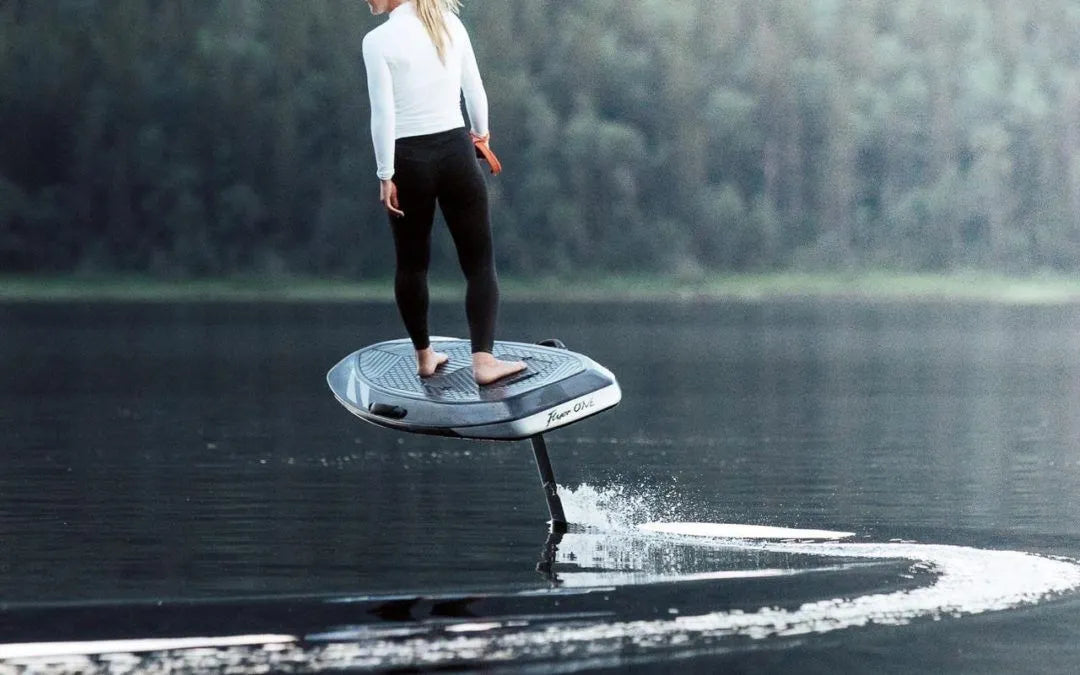
What is the difference between Flyboarding and eFoiling?
Deel
More and more people are visiting our eFoil school in Amsterdam and asking us: "Can you do Flyboarding here?" or "Isn't that flying surfing with an electric surfboard?". Often, we have to chuckle a bit and then tell them that they probably mean eFoiling. I understand the confusion, because you could also say that flyboarding might even be a better name for eFoiling, because with eFoiling you feel like you're actually flying over the water, and the names flyboarding or flysurfing fit very well. So if you're reading this and have also searched online for flyboarding, flysurfing, electric surfboard, or flying surfboards when you meant eFoiling, then you've come to the right place and will find the explanation here 🙂
The similarities between Flyboarding and eFoiling
Let's start by looking at the similarities between Flyboarding and eFoiling.
Firstly, both water sports use a board or plank that you stand on during the activity. Flyboarding and eFoiling can be done both in the sea and on a lake. Finally, both are very spectacular water sports where you will certainly experience enough adrenaline. Ideal for a birthday, family outing, team outing, bachelor party, or company outing.
What is Foiling?
Foil surfing, also known as Surf Foiling or simply foiling, is a form of surfing where, instead of a fin, a mast with two foils, also called wings, is attached to the bottom of the surfboard. This combination is also called a Hydrofoil. The advantage of surfing with a hydrofoil is that, with enough speed, the wings lift you out of the water, thus reducing water resistance. Besides being very spectacular to fly over the water, you are also much more agile and can surf faster in less ideal conditions (for example, lower or weaker waves). In addition to Surf Foiling, the hydrofoil has also become popular in other water sports such as wind foiling, kite foiling, and wing foiling.
What is an eFoil?
eFoiling is basically the same as foiling as described above, but the 'e' in eFoiling stands for 'electric'. This means that these boards are equipped with an electrically powered propeller located at the bottom of the mast. An approximately thirteen-kilogram battery is installed in the eFoil board, allowing you to foil for between 45 and 85 minutes (depending on your experience level and weight). The battery connects to the propeller, which can then be controlled by the remote (also called a controller or remote control) held by the surfer. The advantage of eFoiling compared to foiling is that you can surf in almost all conditions because you have an electric power source. This also makes it very easy for inexperienced surfers to learn.
What is a Flyboard?
Flyboarding is very different from foiling or eFoiling because with Flyboarding, you need a jet ski that sucks in water and then sprays it out with high force through one or two thick hoses attached to your board/feet. This creates such a strong force that you are propelled out of the water.
What are the biggest differences between Flyboarding and eFoiling?
There are quite a few more. First of all, there is a big difference in material and technique as described above. eFoiling is more comparable to 'normal' surfing, where you move more over the water, can make sharp turns, and create more forward speed. The art of flyboarding is being able to come upright out of the water. If successful, you can fly higher and lower and also make some forward and backward movements. With more experience on a flyboard, it is also possible to do more tricks such as flips, twisters, and dives. An important difference, and also a disadvantage, of flyboarding compared to efoiling is that with flyboarding you always need a jet ski for propulsion. This means that you always have to go flyboarding with two people, which makes it more time-consuming and costly than eFoiling. Once you can eFoil, you can go on the water by yourself without an instructor. This gives much more freedom and makes it much cheaper. eFoiling is also much easier than Flyboarding. After three sessions of 45 minutes, you can already eFoil very well.
Flyboarding or eFoiling yourself?
Lessons or clinics are offered for both water sports. For Flyboarding, there are various independent organizations that offer this. Generally, with flyboarding, you get 10 minutes of instruction and then you can try it yourself for 20 minutes under the guidance of the instructor who controls the jet ski and thus the jets of your board. The cost for 20 minutes of flyboarding is approximately between 40 and 85 euros. For eFoiling, there are also various smaller companies online that will take you out on the water. Do your research beforehand to determine which school best suits your needs. The schools affiliated with Flying Fish eFoil School have well-trained instructors, additional safety equipment including impact vests and helmets, and follow a well-thought-out lesson plan to ensure you learn eFoiling safely. The costs for eFoiling range from €59.95 (rental without instructor) to €149.95 (private clinic with instructor). If you come with more people, you pay less.